The Spark: 2024 Season
The story begins during the 2024 marching band season. My daughter joined the band as part of the color guard, so naturally, I volunteered with the props team. Most of our work was standard fare: measuring, cutting, building, hauling, and painting. By performance night, we typically had 25 to 30 props spread across the field. But that year, we received an extra request:
"Could we add RGB LED strips to some of the props and control them remotely during the show?"
At first, it sounded like the easiest task in the world. Who doesn't have a couple of $20 LED strips running somewhere at home? How hard could it be to stick them on a prop and make them light up on cue?
I have a background in systems engineering and mess with electronics as a hobby, so I investigated what it would actually take to pull this off in a marching band environment: outdoors, fast-paced, and rough on equipment.
We had a head start. Another band had found success using a wireless DMX setup-mostly off-the-shelf Amazon hardware paired with an open-source lighting controller called QLC+. We ordered what we thought we needed and built a prototype.
Wireless DMX felt like the obvious shortcut. It is a genuine lighting standard, QLC+ supports it out of the box, and the components are readily available. To be fair, it can work. However, the trade-offs became apparent quickly in a field setting. First was cost: once you do the math on transmitters, receivers, and supporting hardware for multiple props, the price climbs rapidly. The second issue was range and consistency. In our testing, maintaining a reliable signal beyond a hundred feet felt hit-or-miss—and on a football field, you don't get a second try mid-show. The problem shifted from simply controlling LEDs to figuring out how to do it reliably, affordably, and consistently every single run.
By the time we had a solution that seemed workable, we were late in the season, and the cost to roll it out across multiple props couldn't be justified. We treated the effort as a learning experience and shelved the lighting idea until the next year. On the bright side, the band had an incredible season, finishing 4th in the state with a fantastic performance.
The Pivot
During the off-season, we explored alternative control methods. While the DMX approach had potential, it fell short in key areas. Next, we looked at the popular WLED approach using ESP-based microcontrollers. It is a fantastic option with a robust open-source ecosystem; the controllers are inexpensive, and because they run over Wi-Fi, the technology stack was familiar.
However, the challenge with WLED was that Wi-Fi isn't designed for reliable, real-time control of many distributed devices spread across a football field. You either need a strong access point and a pristine RF environment, or you end up fighting range, interference, and connection management. When you add battery-powered props, quick setups, and the expectation that everything triggers perfectly on cue, WLED raised the same uncomfortable question as DMX: not could it work, but could we trust it to work every time?
We eventually landed on a different class of solution entirely: small radio modules from Adafruit and SparkFun. Both offer boards built around the RFM69HCW transceiver, designed for low-latency device-to-device communication without needing Wi-Fi, routers, or complex network config. This felt like a much better match for marching band props, where the system must be quick to deploy, field-dependable, and tolerant of imperfect conditions.
We ordered several pre-made boards, specifically the Adafruit RFM69 breakout, and paired them with the SparkFun RP2040 Thing Plus and the Adafruit RP2040 RFM Feather. With the help of generative AI, we quickly assembled working prototypes. For the first time, it felt like we were building something capable of surviving a marching season.
The Key Insight
One design decision made everything click. Instead of transmitting an entire show one pixel at a time, we put a receiver on each prop and stored the lighting sequences locally. A single transmitter could then broadcast a simple cue message triggering specific effects on all props simultaneously. This approach dramatically reduced the over-the-air data load, making timing and reliability achievable at field scale.
We kept the software side practical, using the Arduino IDE to move fast, iterate on hardware without friction, and access a huge ecosystem of libraries. Just as importantly, we used this as an opportunity to test-drive modern AI tools like ChatGPT and Gemini. They helped scaffold the initial firmware, explore radio protocols, and iterate on features. While we still had to test, debug, and validate everything on real hardware, the combination of Arduino plus AI dramatically shortened the path from concept to field-ready code.
The Hardware: PicoLume
We began considering designing our own versions of the development boards. While vendors like Adafruit and SparkFun make top-notch hardware, their off-the-shelf boards didn't cover a few specific requirements.
The biggest issue was running 24V addressable RGB strips while driving the data line at 5V. This required a reliable 5V rail on the prop and a logic level shifter (like a 74AHCT125 or 74HCT245) to translate the microcontroller's 3.3V output to the 5V LED data signal. Since the dev boards didn't include this natively, we were pushed toward a custom design.
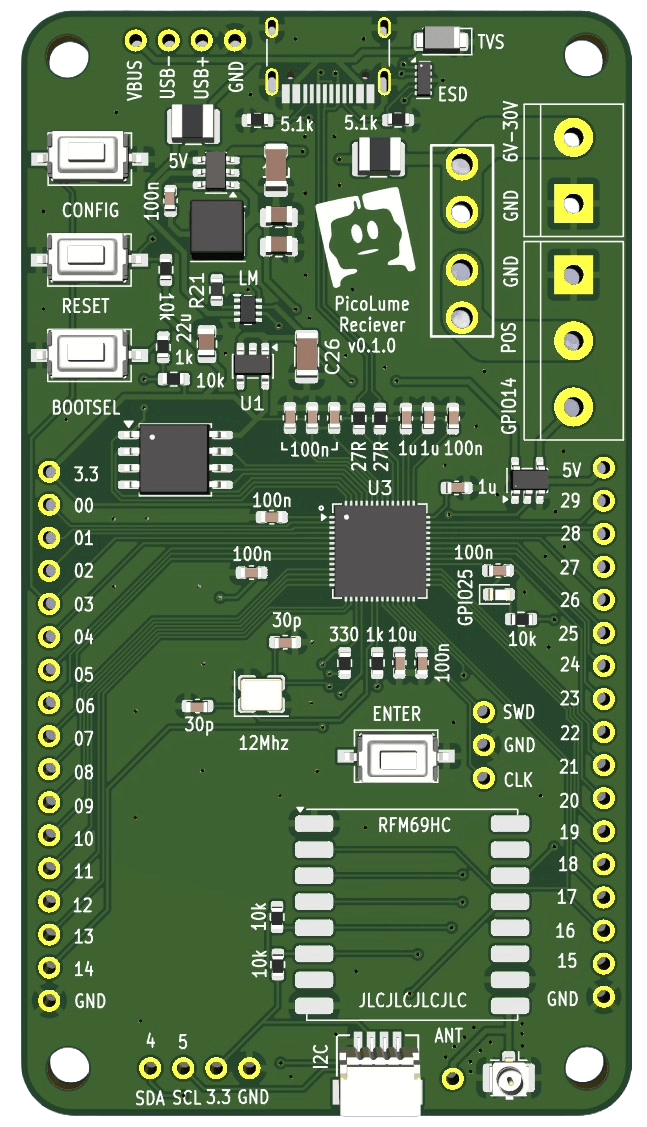
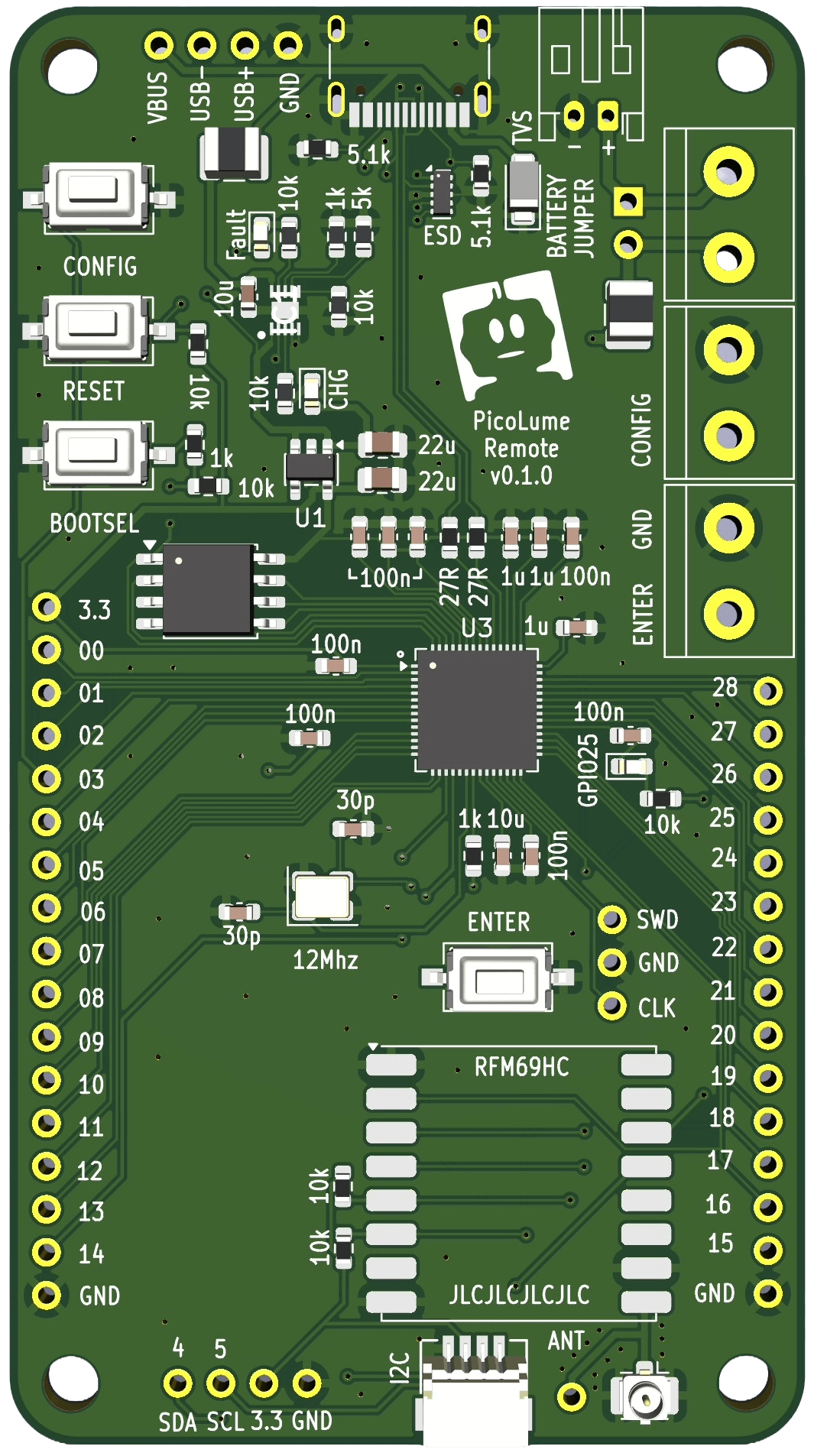
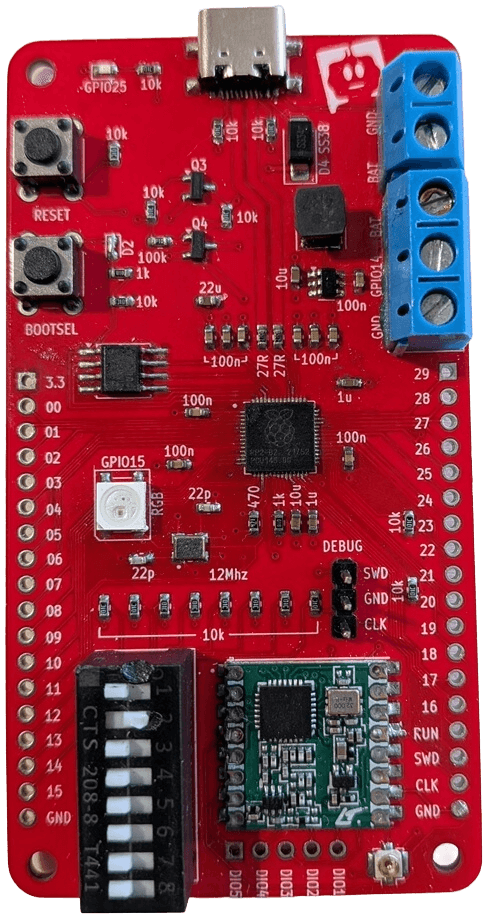
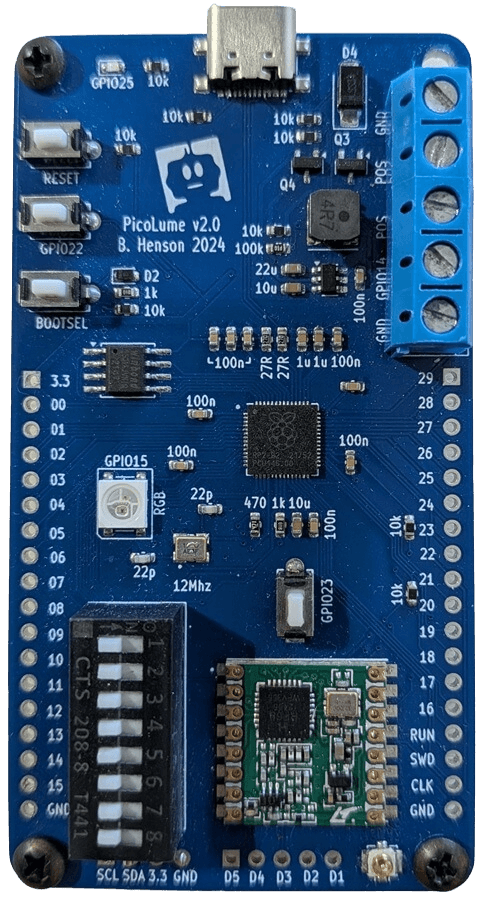
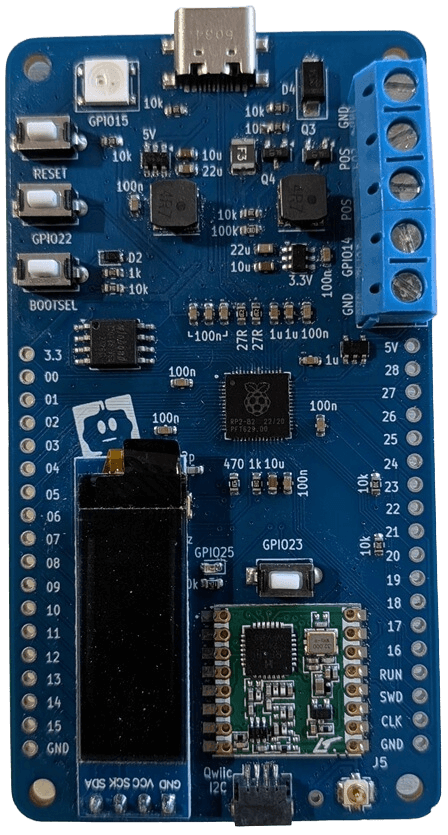
That is how the first PicoLume board started—and it became a great excuse to learn new tools. We used KiCad for the schematic and PCB layout, generated Gerber files, and sent them out for manufacturing.
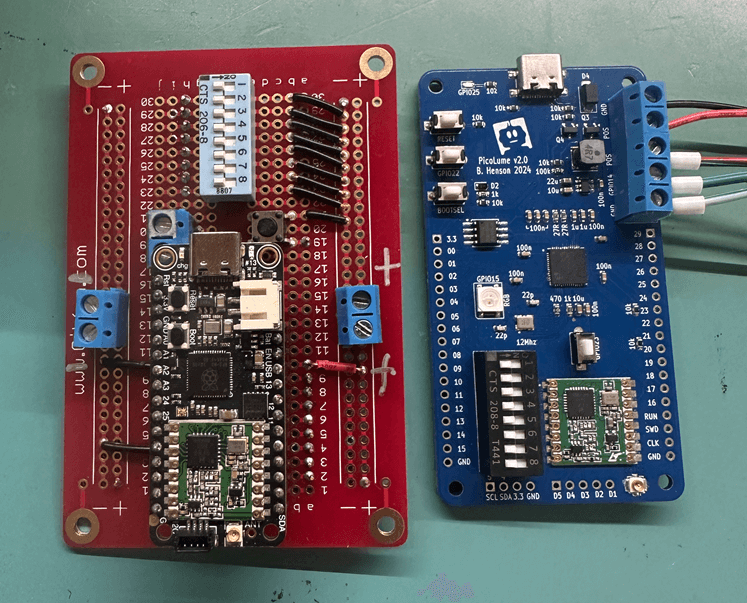
Version 1 was purely an experiment to prove we could design a board from scratch and bring it to life. Assembly took place at a home electronics bench using a stencil, solder paste, and a large PCB hot plate. Surprisingly, it worked. We quickly iterated to versions 2 and 3, adding the missing pieces we needed, including the proper 5V rail and level shifter. In fact, the v3 board eventually found its way into the transmitter for the 2025 season.
The 2025 Season
One factor we underestimated was manufacturing time. Getting PCBs produced and shipped, then hand-assembling them in a non-production environment, introduced significant delays. As the 2025 season drew closer, we didn't have the time or confidence to rely on custom boards for every prop.
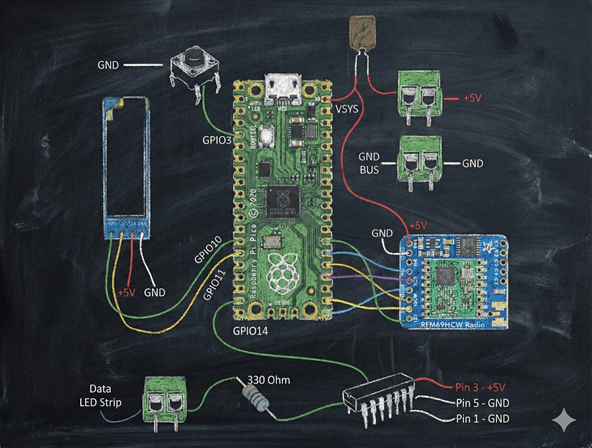
We made a practical call: for the props, we used Raspberry Pi Picos soldered onto prototyping boards along with the level shifter, a polyfuse, and an OLED display. These "rough and ready" builds became our functional field units for the season.
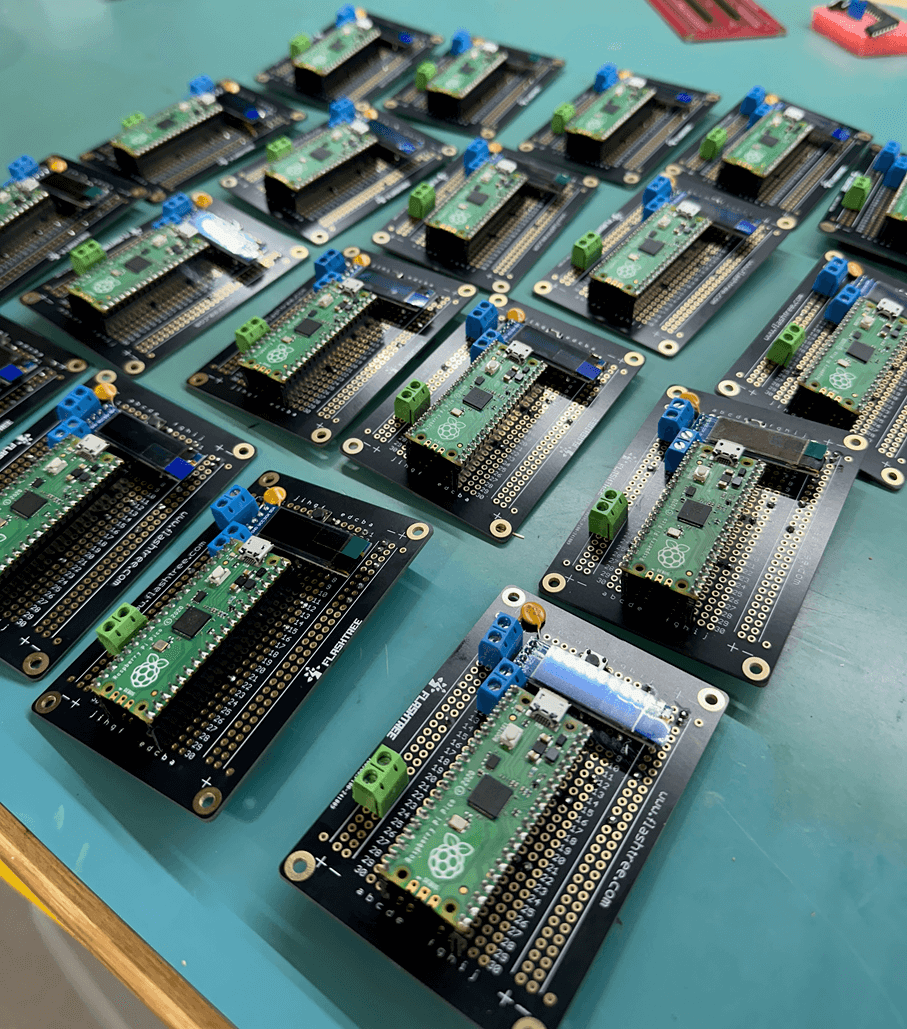
Scaling up proved challenging; even 20 units was a larger operation than expected. It took several weeks to prepare, assemble, and test everything. In the end, however, we had a working system at a reasonable price point. All in, the complete setup cost around $3,000, which covered 18 fielded props with lights, two backup units, and two remote controllers.
Gallery (click to enlarge)
Early Lessons
The first few shows were not flawless. When spread across the field, not every unit stayed synced to the transmitter. Some LEDs displayed strange artifacts, and one prop failed to respond entirely. We treated early performances as operational tests and worked through the problems one by one.
- We improved coverage by configuring some props as repeaters.
- The visual artifacts were traced to a missing inline resistor on the microcontroller's data output.
- The dead prop was the simplest failure of all: a wire that was never soldered.
By the state competition, the system was solid. The props worked perfectly, the team was thrilled, and to top it off, the band took 4th place again with another fantastic show. The director did a great job using LEDs intentionally, just enough to elevate key moments without trying to force lighting cues into every possible beat.
Looking Ahead
After the final competition, we began assessing our needs for the next year. One of the biggest challenges was the programming workflow. At the time, every sequence was hand-coded directly into the firmware on the receivers and remotes. While this was manageable for a few, especially using AI tools to generate or tweak code, it made designing a full show difficult for most people.
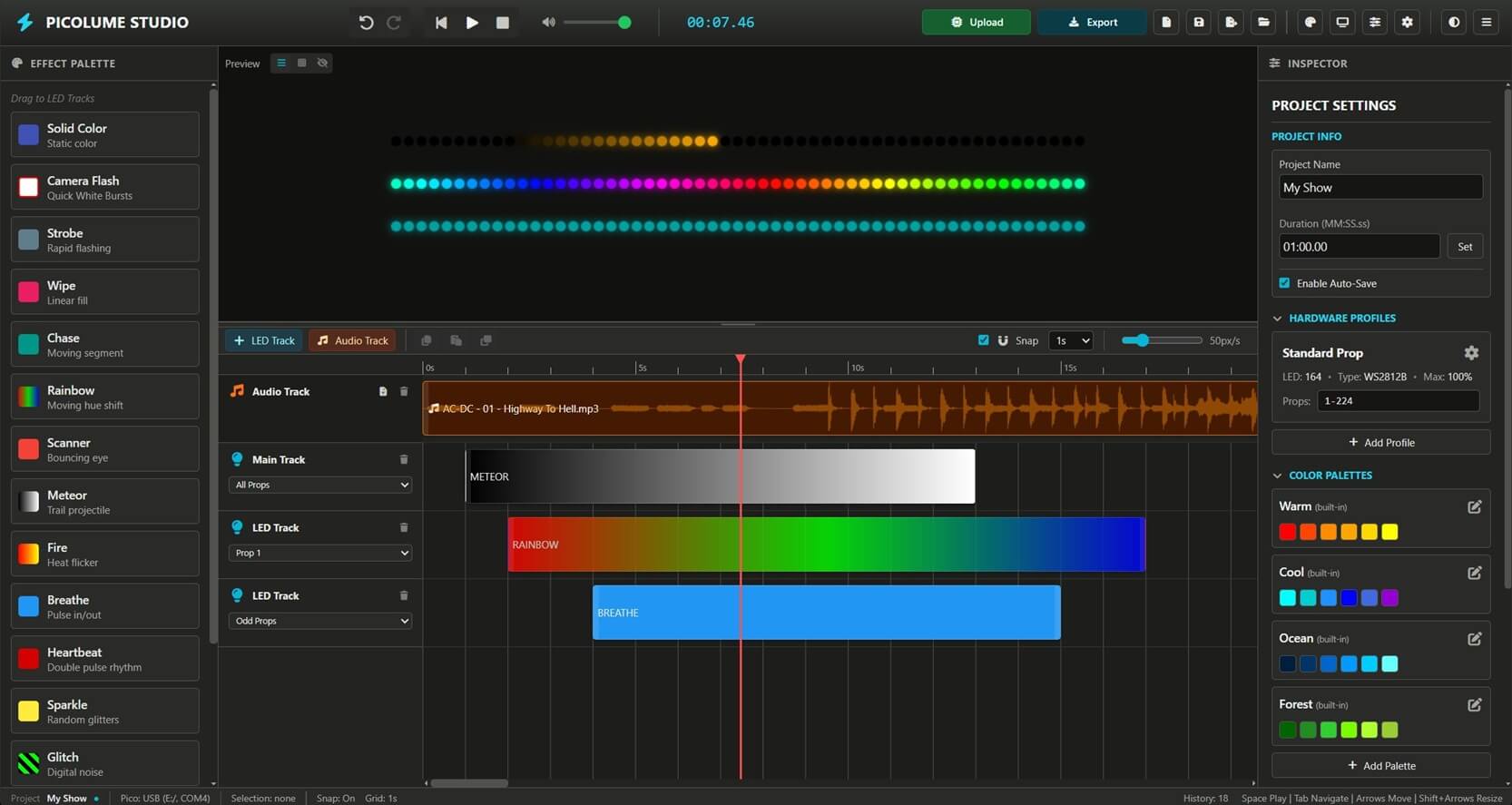
What we really needed was a visual way to build a show along a timeline. We needed a tool that could use music as a reference and, most importantly, still work with our existing hardware.
We set out to prototype a timeline designer application. With the help of LLMs, our early attempts were simple web interfaces, mostly intended to prove the concept. We successfully represented all the core pieces in a browser: a library of LED sequence clips, a timeline for lights and music, basic settings, project saving and loading, and even a method to communicate with our existing hardware. That effort eventually evolved into the PicoLume Studio application.
Open Source Commitment
Along the way, it became clear that we likely were not the only band trying to build a lighting system that was both affordable and reliable. If we faced these hurdles, chances are other programs have too. That realization made the decision easy: PicoLume will be fully open source, including the hardware designs, firmware, and the Studio software, so other bands can use it, adapt it, and improve it.
Meanwhile, development continues. A next-generation board is already in progress, incorporating lessons learned from the 2025 season.